Exactly 50 years ago, a revolutionary way of coding products was born. Leaders from global giants such as Heinz, General Mills, Kroger, and Bristol Meyer understood that supply chain efficiency depended on a common language. The result of this collaboration was the Global Trade Item Number (GTIN), a solution with endless possibilities that remains the global gold standard today.
The DNA of Global Identification
The GTIN (Global Trade Item Number) acts as the DNA of a commercial item. Just as the human genome contains all the instructions for an organism's development, the GTIN carries the unique identity of a product across any global market. This standardization, managed by GS1, eliminated the logistical "Tower of Babel" where every company created its own internal codes (proprietary SKUs), making communication between different partners' systems impossible.
Thanks to this structure, a product manufactured in Europe and shipped to a warehouse in Chicago is recognized instantly. This interoperability is what allows global supply chains to function without friction, ensuring that the physical item and its "digital shadow" (the data in the WMS) are always in perfect sync.
The Hierarchical Structure of the GTIN
It is not a random sequence. A GTIN is composed of prefixes that identify the company's country of origin, the manufacturer's code, and the specific item reference. This hierarchy ensures that no two different products in the world will ever share the same code, eliminating the risk of inventory overlap in large marketplaces or global logistics providers.
Revolution by the Numbers
GS1 statistical data demonstrates the colossal scale of this implementation:
- 100 Million Products: This is the database of unique commercial items. Having an assigned GTIN means the product is "world-ready," accepted by giants like Amazon, Google Shopping, and major retail chains.
- 2 Million Companies: From small SMEs to multinationals, adopting this standard is the minimum requirement to enter formal and digital commerce.
- 6 Billion Scans per Day: Every time a code is scanned in a warehouse using LogisticsWMS or at a supermarket checkout, a data transaction occurs that validates stock, price, and expiration. This frequency makes the GTIN the most successful communication protocol in human history.
Critical Importance for Data Integrity in WMS
In the context of a smart warehouse, the GTIN is the anchor for all information. Without a unique, standardized identifier, it would be impossible to automate processes such as Cross-docking or Reverse Logistics. LogisticsWMS uses the GTIN as the "primary key" to ensure that, upon scanning, the system knows exactly which dimensions, weight, and storage restrictions (such as temperature or hazardous material protocols) apply to that specific item.
GTIN vs. Barcode: What is the Difference?
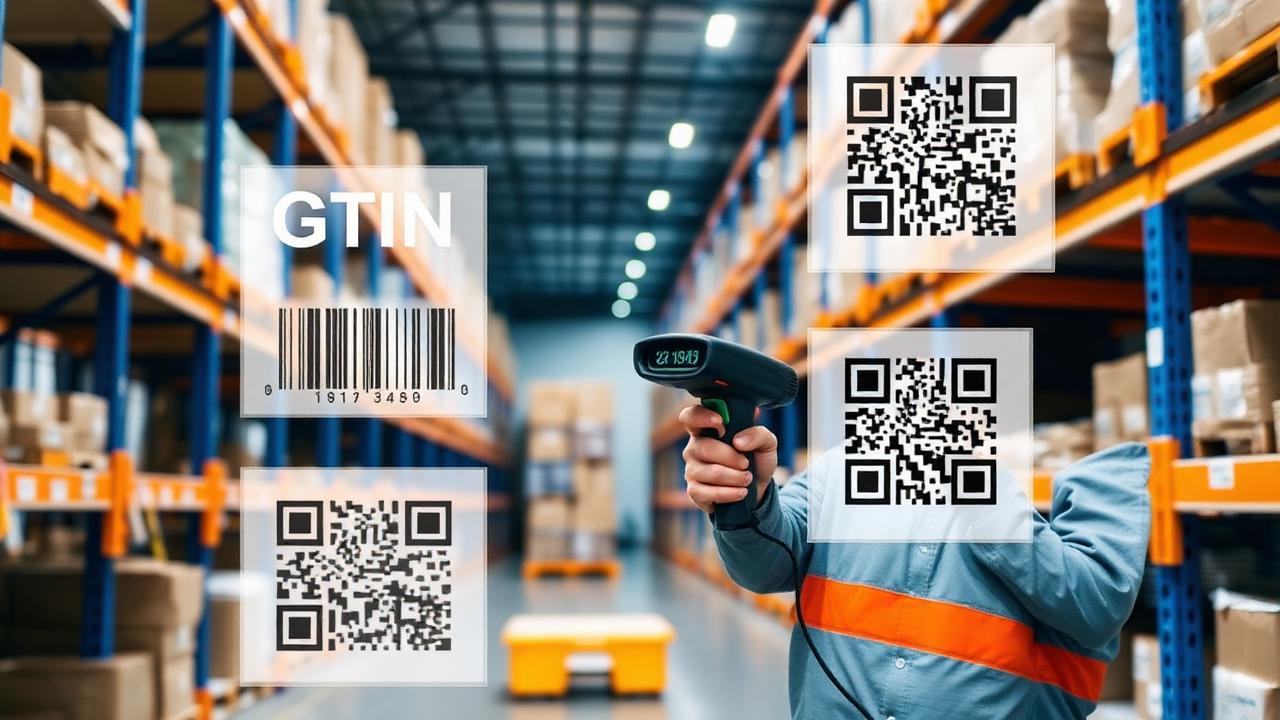
Often confused, these concepts are distinct yet complementary. The GTIN is the information (the 8, 12, 13, or 14-digit number), while the Barcode is the graphical carrier that allows for the optical reading of that information.
Historically, the GTIN-13 (EAN-13) has been the norm in European retail, but technological evolution has introduced new carriers. The GTIN ensures full traceability from production to the end consumer, serving as the master key for data exchange between systems across different logistics partners.
The Evolution: From Manual Identification to the Laser Revolution
Before the standardization imposed by the GTIN, inventory management was the "Achilles' heel" of the industry. Operations relied entirely on paper records, manual counts, and the memory of operators. This analog model was inherently error-prone: unreadable handwriting or a transposed digit on a receiving form created "ghost stocks" that paralyzed production lines and sales.
The inability to process data in real-time meant companies operated with massive margins of error, resulting in excessive (and expensive) inventories or constant stockouts. Logistics was, until then, the greatest barrier to the scalability of modern retail.
The Laser as a Catalyst for Efficiency
The great technological shift occurred with the adaptation of LASER (Light Amplification by Stimulated Emission of Radiation) for civilian and commercial purposes in the post-war era. The development of scanners capable of interpreting the contrast between the black bars and white spaces of a barcode allowed, for the first time in history, for a product to be "read" instantly and digitally.
This advancement allowed item identification to go from a process of several seconds (or minutes if there was an error) to a fraction of a millisecond. In the first industrial implementations, the introduction of the laser scanner reduced inventory errors by more than 90%, eliminating the need for exhaustive manual checks and enabling automated stock deductions at the exact moment of physical movement.
The Birth of Permanent Inventory
The combination of the Laser with the GTIN gave rise to the concept of Permanent Inventory. For the first time, managers could know exactly what they had in the warehouse in real-time without needing to stop operations for physical counts. This immediate visibility allowed for the implementation of strategies like Just-in-Time and Lean Warehousing, where stock moves with a speed and precision that would have been unimaginable in the era of manual records.
At LogisticsWMS, we honor this evolution by optimizing every laser or optical scan. We know that every "beep" of a scanner represents a critical data transaction that validates the integrity of your entire supply chain, ensuring that the human errors of the past remain where they belong: in history.
The Future: QR Codes and the GS1 Digital Link
Today, the traditional linear barcode is gaining company. The market is migrating toward two-dimensional codes, such as QR Codes and DataMatrix, which can store a much higher density of information.
More Than Just Identification
Through the GS1 Digital Link, a single code printed on a product can now provide:
- Logistics Data: Batch numbers, expiration dates (SSCC), and quantities.
- Consumer Information: Nutritional values, allergen alerts, and environmental impact (carbon footprint).
- Transparency: Origin of raw materials and sustainability certifications.
This transition is vital for Electronic Data Interchange (EDI), allowing governments, companies, and consumers to access valuable datasets for purchasing decisions and regulatory compliance.
Why does your WMS demand correct GTINs?
For software like LogisticsWMS, which promotes a paper-free operation, the correct use of a GTIN is not optional—it is the foundation of productivity.
- Error Minimization: Optical scanning eliminates product mix-ups during picking.
- Processing Speed: We have optimized our validation algorithms so that reading a GTIN executes stock and validity checks in milliseconds.
- E-commerce Visibility: Giants like Google prioritize products with valid GTINs, increasing relevance and sales for retailers who comply with the standards.
Unique Identification as a Business Opportunity
A GTIN is much more than a number; it is the tool that enables interoperability in a globalized market. By adopting GS1 rules, your company is not just complying with a technical standard; it is opening the doors to advanced automation, ethical traceability, and business insights based on real data.
At LogisticsWMS, we ensure that your investment in product coding translates into real efficiency gains. A warehouse that "speaks" the language of the GTIN is a warehouse prepared for the future.