If you manage a logistics operation, you know that picking is often the most resource-intensive and time-consuming activity. Among the various methodologies available, Wave Picking stands out as one of the most effective solutions for organizing workflow in a predictive manner.
But what exactly is it, and how can you know if it is the right choice for your reality? Let's analyze this methodology in detail.
What is Wave Picking?
Wave Picking is an order-organization methodology that groups outbound orders into logical blocks, called "waves." Unlike traditional picking, where orders are processed as they arrive, here the work is released in planned intervals throughout the day.
The process generally follows these steps:
- Aggregation: Orders are grouped based on specific logistics criteria (e.g., transport route, carrier, or warehouse zone);
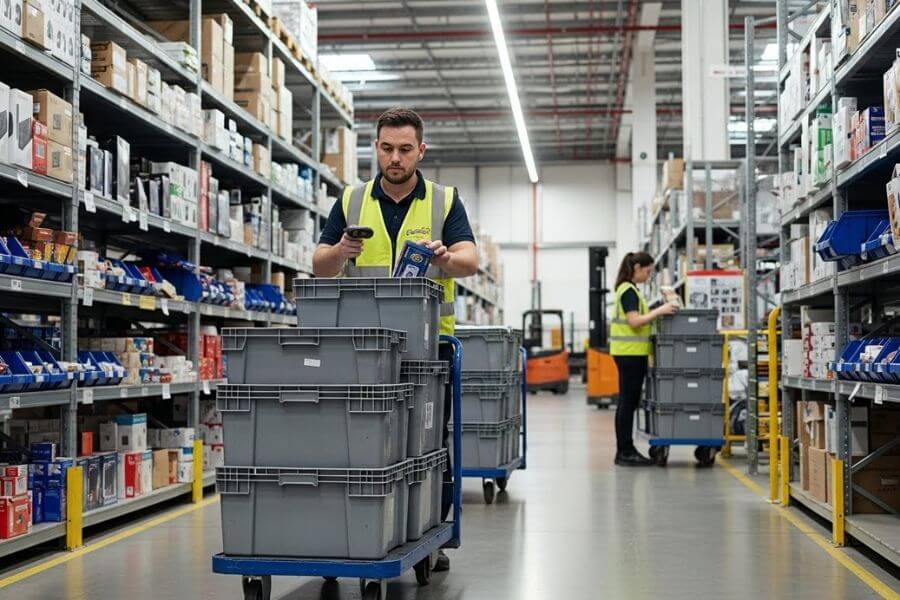
- Assignment: Each wave is assigned to an operator who follows an optimized route to collect all items for that group;
- Finalization: Items are taken to a consolidation area (Packing Zone) to be separated by order and, finally, moved to the Loading Zone.
Aggregation Criteria
You can create "waves" based on truck departure times, the number of lines per order, customer priority, or product type. This organization allows the team to meet specific goals in each shift, rather than just "hoping the work flows."
How to use the Wave Picking method?
Wave Picking combines principles from Batch Picking and Zone Picking. It is extremely efficient when you have many orders sharing the same SKUs.
Instead of an operator going to the same location ten times to satisfy ten different orders, they go only once and collect the total quantity needed for all of them. Afterward, these quantities are segregated for each customer, either at the time of collection (using multi-tote carts) or at the packing station.
The importance of WMS in Wave Picking
Operating with Wave Picking without a Warehouse Management System (WMS) is nearly impossible. The software needs to perform complex data analysis to:
- Calculate the time required for each wave (e.g., 3-hour blocks).
- Plan <a href="/en/glossary/replenishment" class="text-secondary-orange hover:underline">replenishment</a> periods between waves to avoid stockouts.
- Ensure that orders arriving until 10:00 AM are included in the 10:30 AM wave, while the rest move to the next one.
Golden Rule: Once a wave has started, it is "closed." No orders are added or removed until it is finished. This is the main difference from the Waveless Picking model, where the flow is continuous and dynamic.
Should you use Wave Picking in your warehouse?
This methodology is not a universal solution. You should consider Wave Picking if:
- You have a WMS in place: The complexity of aggregating lines and optimizing routes requires automation;
- You operate a Man-to-Product model: Where operators move to locations and items are easily accessible;
- You have a high volume of lightweight SKUs: It is ideal for products that are easy to handle and transport in batches;
- You need synchronization with Carriers: If you have rigid pickup schedules, waves ensure orders are ready at the dock exactly when the truck arrives.