In the world of Fast-Moving Consumer Goods (FMCG) and the pharmaceutical industry, time is not just a variable, it is a critical survival factor. Managing perishable products requires an operational rigor that separates profitable companies from those accumulating losses through stock write-offs.
For industries dealing with health and well-being, such as food and pharma, controlling the expiration date and the best-before date is not just a best practice; it is a legal and ethical obligation.
The difference between "Expiration Date" and "Best-Before Date"
According to GS1 standards, it is essential to distinguish between these two concepts to prevent food waste and ensure consumer safety:
- 🔴Expiration Date (Use-By Date): This determines the safety limit for consumption. Beyond this date, there is a direct health risk (in fresh foods) or a risk of therapeutic ineffectiveness (in medicines). This is a hard limit.
- 🟡Best-Before Date: This indicates the period during which the product retains its specific quality attributes (flavor, texture, color). After this date, the product may still be safe, but its commercial quality declines.
Ignoring these distinctions in the warehouse results in two catastrophic scenarios: shipping unsafe products to the market (reputational and legal risk) or prematurely discarding still-marketable stock (financial loss).
Operational Impact: The 3-Month Rule
Imagine your market or regulator imposes a "Minimum Shelf Life" rule: you cannot deliver products to a customer if they have less than 3 months of remaining shelf life. Without technology, managing this across thousands of SKUs is impossible.
Let's analyze how LogisticsWMS transforms this challenge through three critical use cases:
Use Case 1: Intelligent Inbound Filtering
The most common mistake is accepting stock that is already "dead on arrival" at your warehouse.
📦 Scenario: A supplier delivers a batch with 4 months of validity. If your product typically stays in stock for 2 months before being sold, and you have a 3-month minimum shelf life rule for shipping, that product will be blocked before it can ever leave the facility.
✅ Solution: In LogisticsWMS, you define receiving alerts. If a product has less than X months of shelf life (e.g., 6 months), the system issues an immediate warning. You can reject the load at the dock or place it in quarantine for quality inspection, avoiding the costs of storing unsellable stock.
Use Case 2: Visibility and Dynamic Segregation
Stock that is valid today may become obsolete tomorrow. Inventory management must be dynamic.
📊 Strategy: Instead of waiting for an annual inventory count, use LogisticsWMS to extract monthly "Expiring Stock" reports.
💡 Opportunity: By identifying products entering the "critical zone" (e.g., less than 3 months) in the next 30 days, you can create promotional campaigns, outlet sales, or donations. This transforms a total loss into cost recovery or a tax benefit. The system allows you to physically segregate these items, moving them to "Quick Sale" zones.
Use Case 3: Picking Algorithms and FEFO Logic
Picking efficiency is where technology truly pays off. The LogisticsWMS algorithm doesn't just look at location; it looks at expiration.
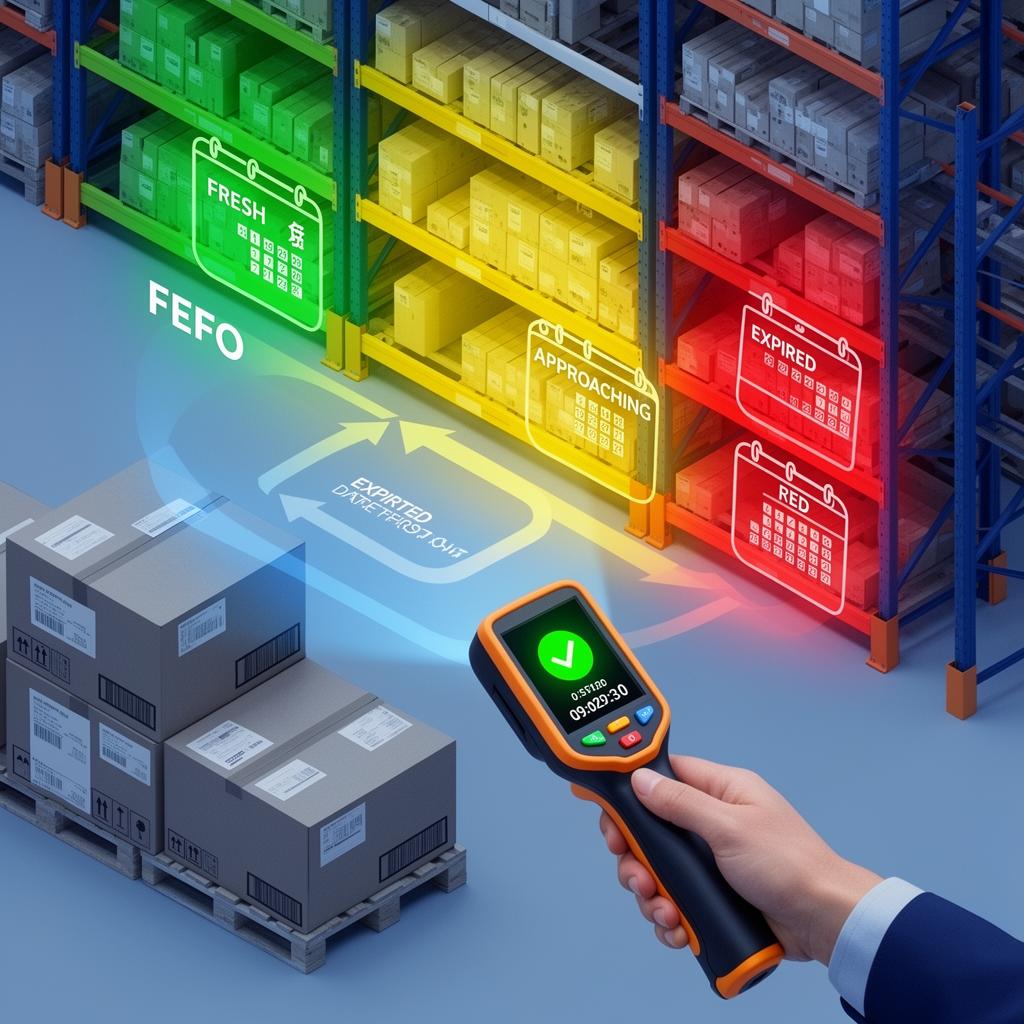
🔄 FEFO (First Expired, First Out): The system automatically directs the operator to pick the batch that expires earliest, ensuring perfect stock rotation.
🛡️ Real-Time Validation: If an order is placed and the only available stock has less than 3 months of shelf life (violating the customer's rule), the system blocks the reservation. The user receives a clear error: "Insufficient stock with permitted shelf life." This eliminates the risk of the error being detected only by the end customer.
Why invest in a WMS for Expiration Management?
Compliance is not just about organization; it is a legal requirement under the scrutiny of international bodies like the FDA or the EMA. With a WMS, traceability is native. Every load unit is linked to a batch and an expiration date from the moment of receipt. If a recall is necessary, the system identifies in seconds exactly where every unit of that batch is, whether it's in stock, in transit, or already delivered to a specific customer. In an Excel spreadsheet, this process could take days, with a dangerous margin for error.
Eradicating Waste and Reducing Shrinkage
The cost of discarded stock is one of the biggest "profit leaks" for an SME. LogisticsWMS acts preventively through FEFO logic. The system doesn't just suggest what to pick; it blocks batches that don't meet requirements and prioritizes the earliest expiring items. This ensures stock circulates intelligently, preventing products from becoming obsolete due to a lack of physical visibility. Financially, the reduction in stock shrinkage is often the primary indicator that pays back the software investment in less than a year.
Shielding Customer Trust and Guaranteed Shelf Life
In B2B, trust is the currency of choice. If a client (such as a major retailer) requires a minimum shelf life of 6 months and you deliver a product with 5 months, you trigger a return, a credit note, and, worse, a stain on your reputation. The WMS acts as an automatic quality filter: the algorithm validates the expiration against each customer's specific requirements at the moment of picking. The result is an "error-proof" operation where your customer knows they can blindly trust every delivery they receive.
From Crisis Management to Operational Excellence
Managing expiration dates doesn't have to be an administrative headache. With the right processes and the support of LogisticsWMS, this management becomes a tool for margin optimization. By anticipating the end of a product's life cycle, you gain the power to decide its commercial fate instead of being forced to discard it.
Consumer safety and your company's financial health are two sides of the same coin. Are you ready to digitize your stock control and eliminate expiration-related losses?